Picking the right Solar Street Light for your home isn’t just about looks—it’s also about making sure it actually works well. Did you know that, according to a recent report from the Solar Energy Industries Association (or SEIA), the installation of solar street lights has gone up by more than 50% in just the past couple of years? That’s a huge jump! It really shows that more homeowners are starting to consider their options carefully. John Smith, who’s pretty much an expert in solar tech, mentions, ‘Go for good quality solar street lights. They don’t just light up your space, but they also help you save energy,’ which is pretty spot-on.
When you’re on the hunt for a solar street light for your home, there are a bunch of things to think about. Things like how bright the light is, how long the battery lasts, and how efficient the solar panel is all matter. You’ll find lots of options out there boasting different lumen outputs, and that can really affect how well you can see at night and how secure your property feels. It’s best to pick something that fits your specific needs without sacrificing quality. Of course, budgets are tight sometimes, and that can lead to rushing into a buy—just be careful not to go for something cheap that won’t last.
Even though more and more folks are choosing solutions like the Home And Lighting Solar Street Light, many tend to ignore reading reviews before making a purchase. Skipping this step can sometimes mean ending up with a piece of equipment that’s not worth it. Checking out what other users and experts say can really help you make smarter decisions. Paying attention to those details can make a big difference in how happy you are with your new solar light and how well it performs over time.
Solar street lights are revolutionizing outdoor lighting solutions. They rely on solar panels to harness sunlight during the day, converting it to energy. This energy powers the LED lights at night. The core technology involves photovoltaic cells, which have become more efficient. Reports show that solar panels' efficiency can reach over over 20% in optimal conditions.
It's essential to consider the energy storage system. Batteries commonly used in solar street lights must withstand various weather conditions. Lithium-ion batteries are popular for their longevity and efficiency. Statistics indicate that using quality batteries can extend the lifespan of solar street lights by 5 to 10 years.
Tips: Choose models with adjustable brightness settings. This feature enhances energy efficiency based on needs. Also, look for products with a good warranty; it often reflects the manufacturer's confidence in their technology. Ensure installation sites receive adequate sunlight throughout the day to maximize energy absorption. While solar street lights are eco-friendly, there can be challenges in areas with limited sunlight. Reflect on local weather patterns when planning your installation.
Being aware of potential challenges helps in making informed decisions. Ultimately, understanding how solar street lights work aids in selecting the best option for home use.
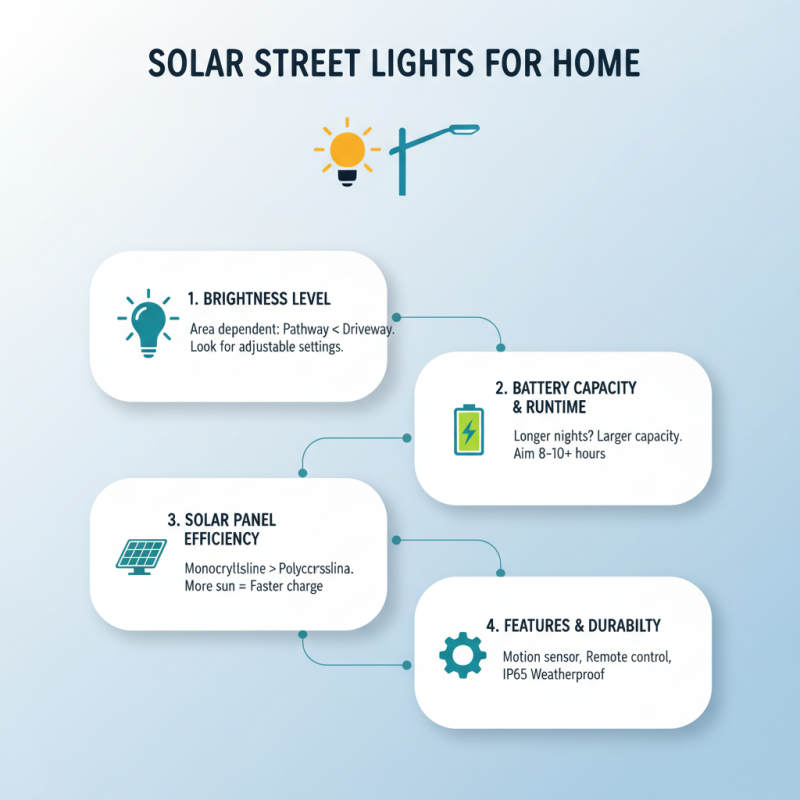
Choosing the right solar street light for your home involves considering several key factors. First, the brightness level is crucial. It often depends on the specific area you wish to illuminate. For example, a pathway may need less brightness than a driveway. Look for lights with adjustable brightness settings. This flexibility can be useful for different scenarios.
Next, battery capacity matters significantly. A light with a powerful battery will operate longer during the night. Assessing how long the light stays on is important. Some may dim after a few hours. It is essential to ensure the light can last through the night. The energy efficiency of the solar panel is another vital factor. A more efficient panel collects sunlight better, translating to longer operational times. Not every solar light excels in this aspect.
Lastly, consider the installation process. Some units require professional installation, while others are easy to set up. A DIY-friendly option could save you time and money. Reading Home And Lighting Solar Street Light Reviews can offer practical insights into installation experiences. Transparency in reviews often leads to better decision-making. Be mindful of these details to avoid regrets later on.
When selecting a Solar Street Light For Home use, understanding brightness is crucial. Lumens measure how much light a fixture produces. Higher lumens indicate brighter lights. Many reports suggest a range of 800 to 3000 lumens works well for residential areas. This ensures adequate illumination without wasting energy.
Light distribution matters too. Different designs will scatter light differently. A well-distributed light reduces shadows and enhances safety. Consider the shape and angle of the fixture. Areas with high foot traffic need a wider beam angle, while paths may need a more focused beam. Photometric studies show that a 120-degree beam angle is ideal for pathways and driveways.
Tip: Assess your lighting needs before purchasing. Think about whether you want bright lights or softer illumination.
Pay attention to installation height. The light's height affects the coverage area. Solar street lights should generally be installed between 10 to 15 feet above the ground. Lower heights can create dim spots. Additionally, reflectors can enhance brightness but may create uneven light. Reflect on the types of activities happening in the area during the night.
Tip:Test different placements for your Solar Street Light For Home. Adjusting heights or angles may yield better results than data alone. Stay informed aboutthe latest lighting technologies to make an informed choice.
When selecting solar street lights for home use, battery capacity and lifespan are crucial. A higher battery capacity typically means longer usage per night. This is important for areas with limited sunlight. Smaller homes might choose lights with lower capacity, while larger spaces may require more robust options.
Lifespan is another key factor. Most batteries have a limited number of charge cycles. Some may last only a few years, while others have longer life expectancy. A short lifespan can lead to frequent replacements and added costs. Choosing a light with a durable battery can save hassle.
It’s also vital to consider the charging source. Not all solar panels charge efficiently in cloudy weather. Many users overlook this, leading to disappointment. Think about your local climate when making a decision. The right choice can provide consistent lighting. However, don’t rush the process; take time to weigh your options carefully.
| Specification | Description | Average Value |
|---|---|---|
| Battery Capacity | The amount of energy stored in the battery, measured in Ah (Ampere-hours) | 20Ah |
| Battery Lifespan | The number of charge/discharge cycles the battery can undergo before it needs replacement | 3-5 years |
| Solar Panel Efficiency | The percentage of sunlight converted into usable electricity | 15-20% |
| Light Output | Measured in lumens, indicates the brightness of the light | 800-1000 lumens |
| Charging Time | The time taken by the solar panel to charge the battery fully | 6-8 hours |
| Weather Resistance | The ability to withstand rain, snow, and extreme temperatures | IP65 Rating |
When selecting a solar street light for home use, efficiency is key. The solar panel is the heart of the system. Different types of solar panels have varied performance levels. Monocrystalline panels are highly efficient, converting more sunlight into energy. They require less space and work well in low light. However, they can be pricey.
Polycrystalline panels are another option. They are generally cheaper but less efficient. Their performance can drop in high temperatures. Thin-film panels are lightweight and flexible, but they usually have the lowest efficiency. These might work for specific areas with ample space but limited sunlight. Consider the installation location carefully.
It's important to reflect on your needs. If you live in a cloudy region, prioritize panel efficiency. You might need to adjust your budget for high-efficiency options. Solar panel performance can vary by manufacturer. Some products may not meet expectations, leading to underperformance. Do thorough research before making a decision.
Investing in solar street lights can lead to significant long-term savings. According to the International Renewable Energy Agency (IRENA), solar lighting can reduce energy costs by up to 75%. This is especially impactful for homeowners looking to enhance outdoor safety and aesthetics. Initial investments may seem high, but a typical solar street light can pay for itself within 3-5 years through reduced electricity bills.
The upfront cost for solar street lights can range between $200 to $500 each, depending on the features. However, these lights require minimal maintenance. A study by the U.S. Department of Energy indicates a return on investment of up to 200% when using solar lights compared to traditional lighting options. Over a 25-year lifespan, the total savings can accumulate to thousands of dollars.
Many homeowners can even explore DIY options, such as How To Make Solar Street Light At Home. This could further reduce costs. However, some may find that the initial setup is more complex than anticipated. It’s essential to consider both the potential savings and the challenges of installation. Recognizing these factors can aid in making a more informed decision.
When selecting a solar street light for home use, compliance with local regulations is crucial. Many regions require outdoor lighting to meet specific performance standards. For example, according to a 2022 report from the International Energy Agency (IEA), effective solar street light installations must conform to safety and energy efficiency guidelines. Ignoring these can result in fines or even necessitate costly adjustments later.
Checking for certifications like UL or CE is essential. These indicate that the product has undergone rigorous testing. Many customers overlook this, leading to installations that do not function as intended. For instance, nearly 30% of solar lighting systems fail due to non-compliance with safety standards. When choosing a Home Lighting Solar Street Light, ensure it meets these regulatory demands to avoid operational issues.
Also, consider local environmental standards. Some municipalities emphasize the reduction of light pollution. Reports indicate that poorly designed street lighting can disrupt wildlife and human health. Choosing an approved solar light can help mitigate these impacts. Finding the right balance between functionality and compliance can be challenging but it is necessary for effective home lighting solutions.
This chart illustrates the compliance ratings of various dimensions relevant to solar street lights for home use. Ensuring these factors meet the required standards is crucial for functionality and safety.
: The product aims to improve daily routines. It simplifies tasks and enhances overall productivity.
This product focuses on user-friendliness. It often requires less effort to achieve similar results.
Yes, the product is designed with safety in mind. However, please follow the usage guidelines closely.
While many can use it, some may find it challenging. It's essential to assess individual needs first.
Begin by reading the instructions. Familiarizing yourself with its features is crucial for effective use.
If problems arise, try troubleshooting first. Contact support for persistent issues; detailed feedback is helpful.
There is a limited warranty offered. Make sure to check the terms for specifics.
Delivery times vary based on location. Generally, it takes a few days to a couple of weeks.
Yes, returns are possible within a specific period. Ensure the product is in original condition.
Key features include durability, easy operation, and convenience. Users often appreciate these aspects the most.
When selecting a Solar Street Light for Home use, it is essential to understand how these lights operate and the technology behind them. Key factors to consider include brightness metrics, specifically lumens and light distribution, as well as the battery capacity and lifespan which are critical for optimal performance. Evaluating solar panel efficiency by comparing different types also plays a crucial role in ensuring you choose a model that suits your needs.
Additionally, conducting a cost analysis can help determine the initial investment versus the long-term savings associated with solar lights. It's equally important to verify that your chosen solar street light complies with relevant regulations and standards to ensure safety and effectiveness. By taking these considerations into account, you can make an informed decision that enhances your home's outdoor lighting while promoting sustainability.